CMWA Blog
This is a spot where we are going to publish some of the articles that appear in out newsletter. We hope you like them. Don’t forget to subscribe to the newsletter. It’s free.
CMWA: 25 years of Woodworking Craft
By Bob Filipczak
When you start talking about our 25 years together, the conversation needs to start with Rollie Johnson. Rollie started the Central Minnesota Woodworker’s Association (the CMWA) in 2001 and has been an active leader and member to this day.
“The way it started is that I knew probably a half a dozen or so woodworkers in the area, and I thought there's got to be more people interested in serious woodworking than just the few of us. So, I put together a flyer, and it was just a little flyer,” Rollie said. It announced a meeting for interested folks at the St. Cloud Library in January of 2001.
“I mailed a bunch of them to cabinet shops in the area. I sent them to Home Depot and Simonson’s and Matthew Hall,” Rollie explained. He reserved a small meeting room, but it had been double-booked and the library gave him a bigger room down the hall. Good thing, too.
“It was kind of funny,” Rollie said. “I thought we would probably have a half dozen people in this big room. Well, it turned out that we had around 50 people show up for that first organizational meeting. By the end of that meeting, we had eight volunteers to form a steering committee and then we were off and running.”
History
Rollie incorporated the club in 2001, and the first year of the meetings were at Rollie’s commercial woodworking shop in Foley. Members commented on the long drive, so the club tried a few other peoples’ shops. Then Rollie gave a presentation to the Sauk Rapids Rotary and mentioned that the CMWA was looking for a more permanent location.
Greg Vandell, then superintendent for the Sauk Rapids school district, said they might be able to help. Rollie met with the folks who ran the adult education program for Sauk Rapids and they made a deal with the school district: “We would teach outreach programs in trade for a venue to have our meetings,” Rollie explained. The meetings then switched over to the Sauk Rapids Middle School and the CMWA ran an outreach program for kids ages 11 to 13.
During a remodel, the location for the club switched over to the old high school for three or four years. Then the school district decided that woodworking was too dangerous for kids and the CMWA needed a new meeting place.
The Paramount Center for the Arts welcomed the CMWA to use their facilities downtown for meetings. And that worked for a while, Rollie said, but, “The problem with the Paramount: it was a nice place to have meetings, but we couldn't do any demonstrations of any kind because we couldn't use power tools down there.”
Rollie began talks with the Paramount as well as the MMAW (Mid Minnesota Association of Woodturners). Originally the MMAW was part of the CMWA, but they split off later as their club grew. After lots of meetings and proposals, both clubs got permission to use the Paramount Tech Center in Waite Park.
The space was also being used by the Great River Theater to make sets a couple of times a year, but eventually GRT moved out. That’s when the CMWA got to call the Paramount Tech Center home. As Rollie put it, “It was an advantageous thing, and it's very unique in that we're one of the very few clubs that has our own shop.”
The CMWA has been at the Paramount Tech site for the past eight years.
A Shop of Our Own
As any woodworker will tell you, having a dedicated shop is a big deal. It’s more than a room full of tools. It’s a refuge, a design studio, a workshop, a classroom where you teach yourself—sometimes by trial and error—and a lot of other things.
When CMWA got a shop of its own for the club, it was a great leap forward. The Waite Park building houses the CMWA, MMAW and a woodcarver’s group as well. For CMWA, it’s where we conduct classes, hold board meetings and monthly meetings with presentations and have open shop twice a month.
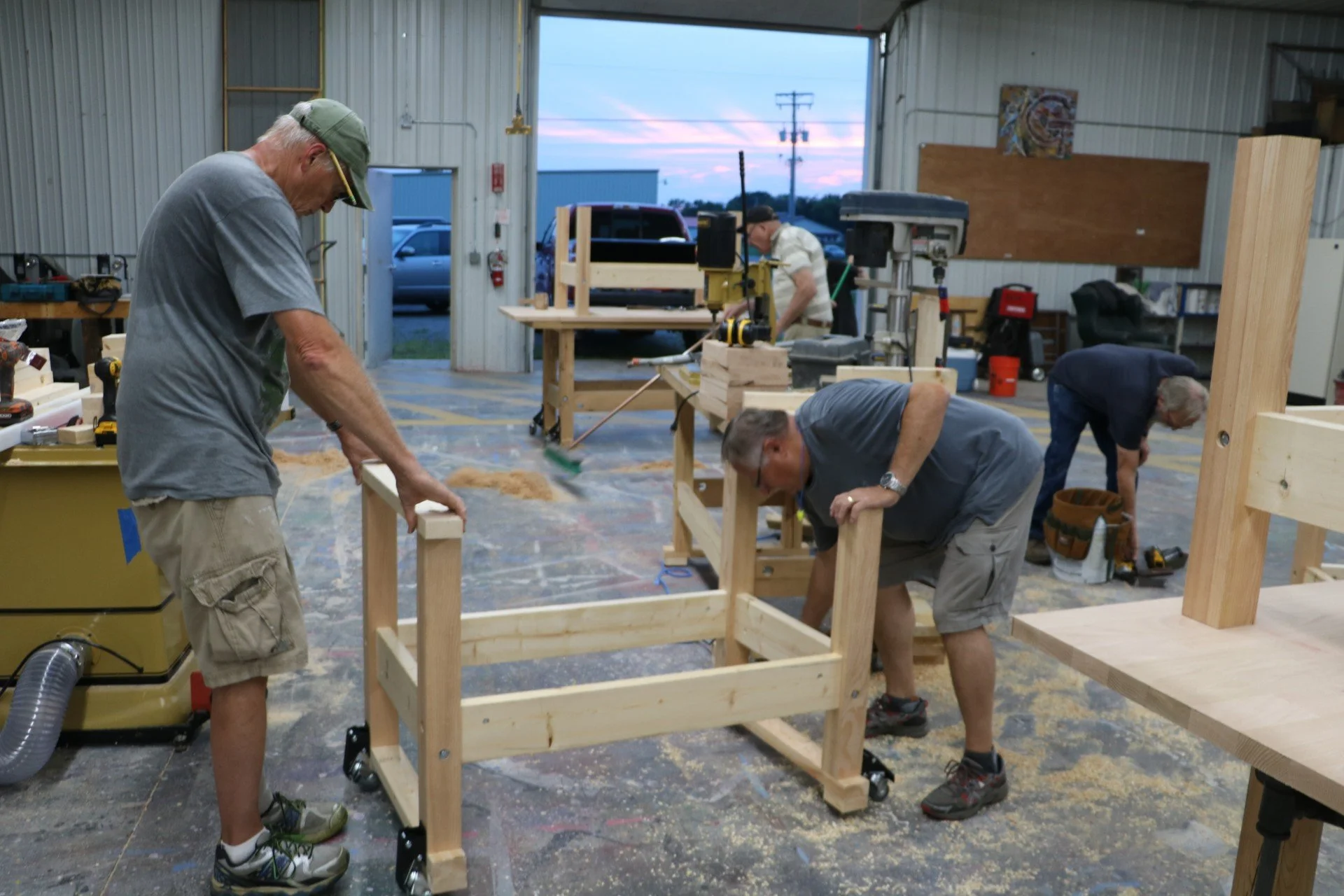
Once we had our own space, we began to equip it with tools and workbenches. There are more than a dozen workbenches, and building those was a club activity than involved a lot members and a lot of work and a lot of oak. (See The CMWA Shop sidebar) Consequently, we can run classes where everyone gets their own bench. In terms of tools, we have collected a very comprehensive collection of equipment, including table saws, band saws, hand planes, jointers, planers, sanders, routers and tables, scroll saws, lathes, and sharpening wheels.
How did we get all the tools? Over the years, and especially since we got a permanent home, tools came from donations from our members. Rollie has done a lot of tool and equipment reviews for Fine Woodworking, and the companies who sent him them typically don’t want them back. Rollie has regularly donated them to the CMWA.
As impressive as the shop and equipment are, CMWA is really about the people who keep it running and who participate in club activities. While many of our classes are taught by members, themselves nationally recognized woodworkers, their connections to the greater woodworking community mean we often have national woodworking experts, like Mike Pekovich, come to teach the workshops and seminars. “It always comes down to the people that volunteer to help with the classes, because it's always a lot of work putting those things together, getting the materials ready, doing all the logistics of it,” Rollie observed. “I guess really the biggest thing is that we have a great facility and we have access to nationally renowned educators,” Rollie explained, “which is a real benefit for us because most smaller schools don't have that ability.”
National and International Members
When we talk about our renowned members with a national reputation—which we don’t very often because we are, after all, Minnesotans—we need to start with Rollie himself. Rollie is both nationally and internationally known in woodworking circles. His long-term relationship as a contributing editor to Fine Woodworking Magazine is first on his list of accomplishments. He is also on the faculty of the Center for Furniture Craftsmanship in Rockport, Maine—one of the foremost woodworking schools in the nation. If we went on to list all of his awards and accolades, we would run out of room.
Steve Schwartz is also a member who teaches nationally. He also goes to New Zealand once a year, for a month, to take woodworking classes there. Steve often volunteers to do demonstrations at our meetings and we have videos of his presentations .
Our own Don Peterson, current Vice President and coordinator of our course offerings through the Paramount, won an award last year at the Minnesota Woodworkers Guild Northern Woods Exhibition. This year he is teaching a class in Kansas. He helped bring in Roger Knudson to speak about design at one of our meetings last year.
Highlights
Charlie Meyer has been with the CMWA from the beginning as part of the original steering committee. He has also served as President. Two highlights he remembers from his time with CMWA involve clocks.
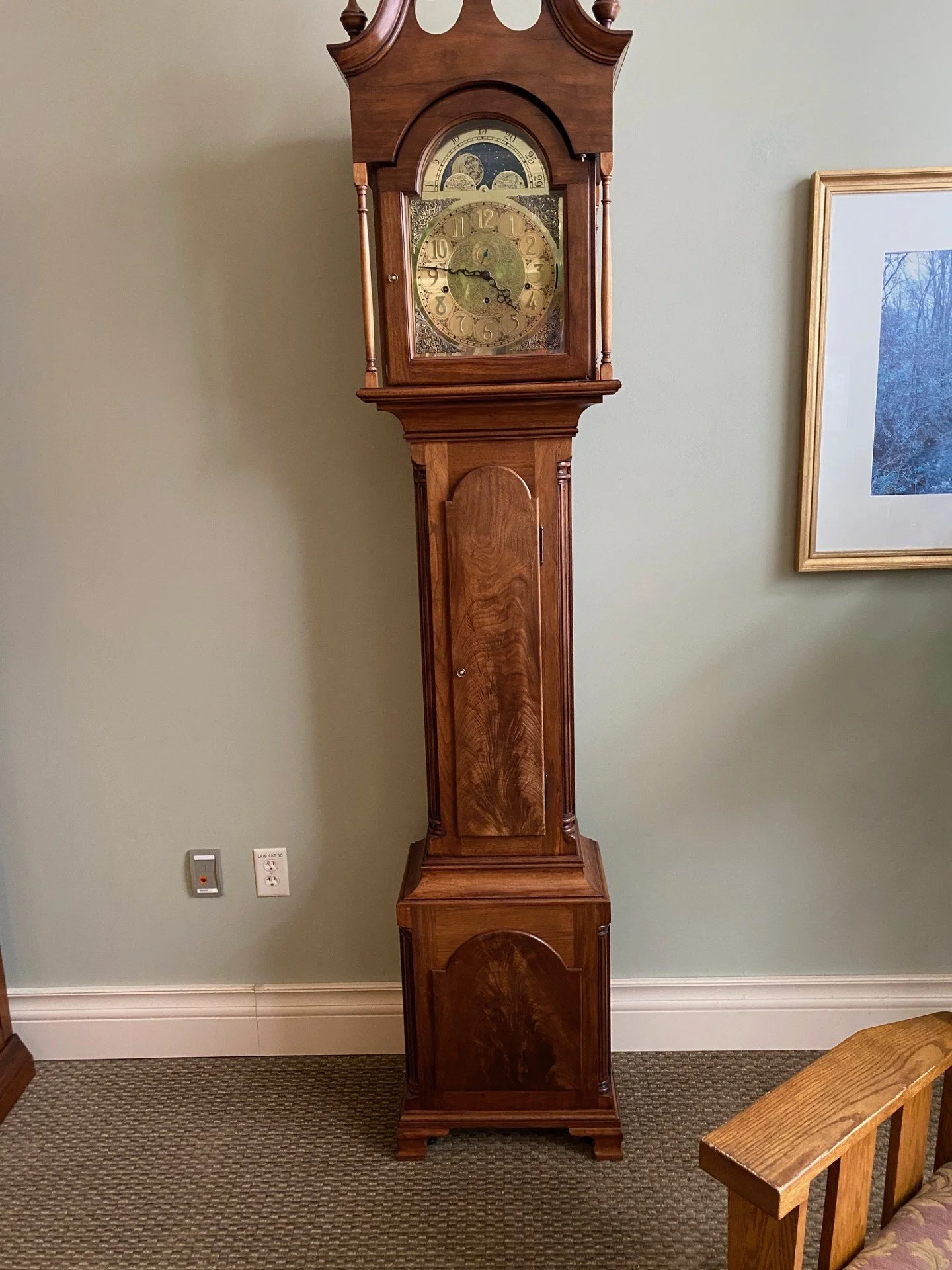
The first clock is a grandfather clock that CMWA built for the Gorecki Guest House, which is associated with Centracare’s St. Cloud Hospital. (It provides short-term housing for anyone receiving healthcare at the hospital, which is right across the street.)
The second clock was, again, a grandfather clock. He and member Mark Voigt worked to finish this project in 2024 after Tom Rosga, our newsletter editor, passed away. The project was featured in an article for WJON.
Fellow Minnesota Craftsmen Complete Late Woodworker’s Grandfather Clock
Charlie said the Rosga clock was one of the most fun experiences he has had at CMWA, mostly because he got to work with Mark.
Mark agrees. “One of my fond memories is working on that clock. His wife asked us to work on it. So me and Charlie Meyer took on that responsibility and spent quite a bit of one summer doing that.”
Mark teaches many of our courses at the Paramount Tech center and having that space has been a real benefit. “Since we've moved out to the shop, we've been able to keep improving it,” said Mark. “it’s a real fun place to have classes. I've enjoyed teaching the classes in that facility because as class members, students get free membership for the remainder of this year. I'm just excited that we're able to pass on our enthusiasm for woodworking in that way. Prior to being in that facility, we didn't have that opportunity. So that's where I see a big difference.”
Participation
Maybe the most distinguishing feature of CMWA, month after month, is the participation of our members. On open shop nights, the number of members showing up to use tools and work on
project varies widely. Sometimes we only get a few, and sometimes we get a crowd (especially during our Holiday Stocking Stuffer nights in December).
For our monthly meetings, however, our participation is strong—very strong. We typically have 40-50 members on our roster each year. Our meetings have between 25-40 members show up for each presentation, even on some very cold and snowy nights.
That level of participation in our core meetings is what keeps this association strong. As Rollie puts it, “The biggest thing is that we do have a really good facility. And the attendance for most of the meetings is pretty good considering the number of people we have that are members—active members, paid members. A lot of times we have better than half of our membership at a meeting, which is pretty amazing.”
The CMWA Shop
By Don Peterson
The event that stands out in my mind was moving into our current shop. We moved in April of 2017. Prior to that we were meeting in the basement of the Paramount where we couldn’t do any real woodworking. It was great to get together and talk but nothing like having an actual shop space.
Our first meeting at the new shop was April 2017. Devin Middendorf was our President and we spent the first meeting, talking about the future and looking around at our new space.
We quickly got to work and built the tool containment area by June and tried to clean the floor. Power tools were moved in and we started to get organized. Can you believe we used to put all the stationary power tools in the containment area! By August we started the bench build. After that we were pretty much ready to go.
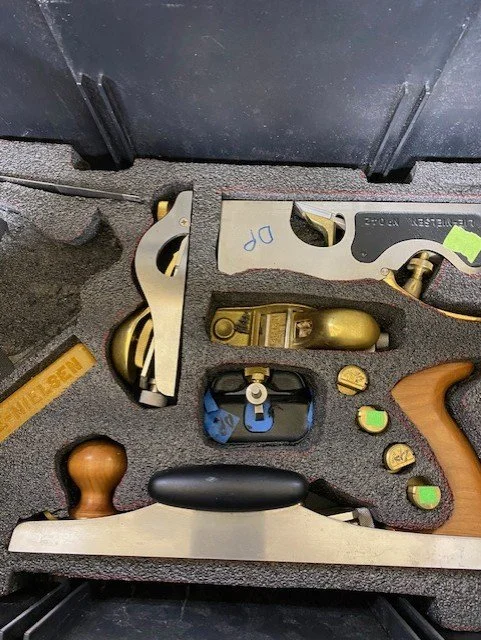
Our first class was in September 2017. Mike Siemsen taught a Sea Chest class that was a big success. We hosted our first Lie Nielsen Hand Tool event in March of 2018. We hope to have them back in the future.
After living with the floor for four years we painted it in July 2021. It was a huge undertaking to move everything, prep and paint the floor. It was a major improvement.
We have since completed a major electrical upgrade, acquired two SawStop table saws, hosted numerous classes including nationally known instructors, and continued to add hand and power tools.
We have a shop to be proud of—that has been supported by countless volunteers who show up any time we need help.
Am I doing this right?
By Bob Filipczak
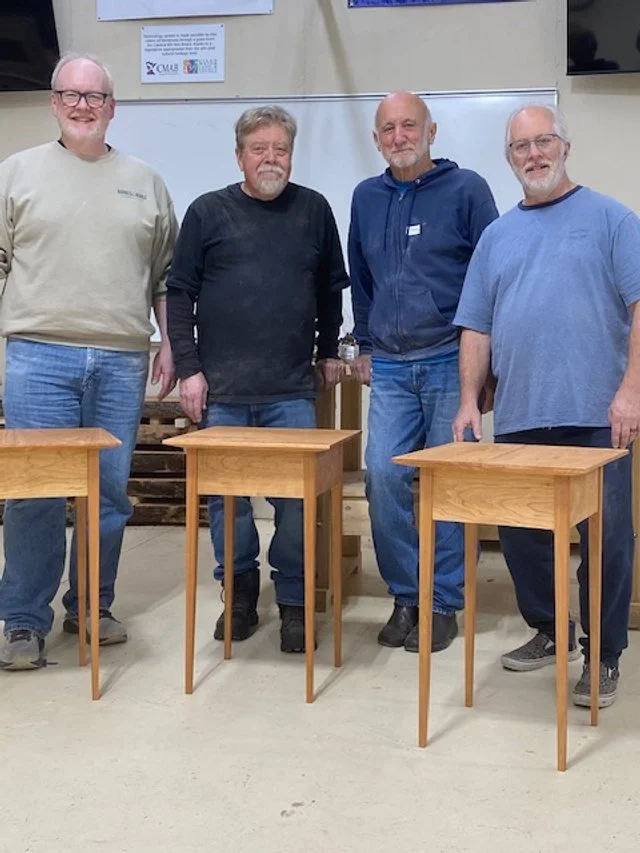
I recently finished one of our classes, “Build a Simple Shaker Style Table” with Don and Tim, and it was a great learning experience. The finished project was just amazing.
During the class I discovered something else–I’m self conscious about my woodworking.
To be fair, this was a very technical project with a lot of unique cuts and jigs. I may have lost count but I think we used about 8 different jigs to get this table to completion. Many friends have commented to me about how “nice” it looks, but I want to say “do you know what it took, simply to get the legs and apron right?” They will never know or understand, but I know and that’s enough.
The hitch was, while I was doing the class, I was constantly checking myself to see if I was doing the different steps right. I mean there’s a right way to cut a board on a table saw–I do it all the time. When, however, I had two teachers, both expert woodworkers, and the other students watching, I lost a lot of my confidence. I kept asking myself, sometimes aloud, “am I doing this right.”
I think that happened with my first CMWA class too. I know it happens a lot when I show up to Open Shop night. I keep wondering if anyone is watching and catching me cutting something wrong or sanding something incorrectly or even holding the tool the wrong way.
I think this stems from what I call the “hermit factor” in woodworking, where folks just hole up in their shops for hours and work on projects without a lot of human contact. They don’t consult with other woodworkers. They often don’t even see their families. It’s a very solitary and, I’m discovering, unsupervised existence. That’s part of the charm of woodworking. You figure out your own way of doing things, solving maybe 20 different problems in an hour. You know the right way to do things, but sometimes you find shortcuts or better techniques. Sometimes you fall into habits that aren’t terribly effective.
But during your shop time, you are the boss, the manager, the project manager and the supervisor. When you step out of the shop, however, and enter our shared CMWA space, things suddenly change. That’s when you start asking questions about your techniques, your shortcuts, your best practices. It can be a bit jarring.
That’s why classes and open shop are so important, even if they are uncomfortable. We have all heard the phrase that we “need to get out of our head.” Likewise, we need to get out of our shop, because we need to take opportunities that force us to ask fundamental questions about our skills, our practices and our approaches to problem solving. Maybe there is a better way? And maybe the only way to find it is through collaboration with other woodworkers.
Am I doing this right? It’s an uncomfortable question, but it may be the first step to better skills as a woodworker.
P.S. When I first started at a woodworking magazine, they hired me to start an ezine, an ancient term for an online newsletter. When we were talking about woodworkers, I asked if they used computers very much, wondering if they would find an ezine useful. It was the beginning of the 2000’s and not everyone was online all the time as we are now. The publisher told me it was remarkable how many woodworkers use computers, he said, and he had the numbers to prove it. He explained that for years, woodworkers all worked in their shops and were rather isolated. Then they discovered the online world, and in particular the message boards, where they could collaborate, solve problems, get tool recommendations and a hundred other things. All of a sudden, he said, they weren’t alone anymore. To them, he added, the computer is just another woodworking tool.
Am I smart or careless?
By Bob Filipzak
I recently “activated” my Sawstop mechanism. You know the one, the device in the machine that jams a brake into the blade and flips the blade into the table–one of the most advanced safety systems in woodworking. That happens if the blade touches your hand, and it’s designed to keep your fingers attached to your hand.
I was surprised and startled because I thought I was being safe. I was cutting a slot into a board with my crosscut sled and I was sure my fingers were well away from, really, everything. My immediate thought was it was a malfunction of the saw. No, I looked at my ring finder and there it was: a tiny chip taken out of my fingernail and an ever-so-slight cut on my finger. It wasn’t even enough to warrant a bandage.
I immediately texted my two friends, Rob and Brian, who helped me assemble the saw when it arrived a few years ago. The text said “my table saw paid for itself today.” They knew exactly what that meant and asked if I was Ok. I sent a photo of my finger to show I was alright.
The average cost of a visit to the ER in America is about $2,600, which is very close to the price of the Sawstop I bought. Hence the “paid for itself” reference.
I told a lot of people about it. First off, I told my family because my five nieces and two sisters were up for the weekend, and I was committed to cooking for them for the next day or so. The idea that I would try to do that with a stitched on, recently severed finger, was probably impossible. Another reason I was thankful for the Sawstop.
But explaining it was the hard part. On the one hand (pun intended) I was not being careful with a very dangerous tool. So I had to tell them I was careless. On the other hand, I was smart enough years back to get this very safe saw. So which was it: careless or smart?
I bought the saw years ago when I was single and alone. I lived in a rural area away from town, and I knew my dog wouldn’t be able to drive me to the hospital if I had an accident with my saw. None of us, I would guess, think we will ever need that safety feature…until we do.
Back when I worked for Woodworkers Journal, we would get the stories either through the mail or in online communities. The stories were about woodworkers who had spent decades being safe and using all the precautions and safety devices; nevertheless, they had lost a finger or two to the tool. There were common factors in the accident stories that I began to notice like it was late in the day, they were tired, they just wanted to finish one more simple cut. Then bang–all of their years of care and safety got reversed in one instant.
The year I started at the magazine, the Sawstop was introduced at a woodworking show. It was instantly dubbed the hot dog saw because of the demo they did at the expo. Since then it has become a mainstay of the woodworking industry and, I for one, am glad.
The truth is, when I went out to the shop that evening, it was late, I was tired and I just had one quick cut to make–all the things I had learned were the enemies of safe table saw operation. I didn’t listen to my own experience.
So was I smart, for buying the saw, or careless when I activated the safety measures? Probably both. But I also forgot the lessons of my past, the hard-earned lessons of other woodworkers’ experience with dangerous tools. That may have been the most serious mistake of that evening.
